

Before exporting a nesting result, reconcile requested and placed quantities for every part type. A dense preview proves that some geometry was arranged; it does not prove that the complete order is present. Treat any unplaced quantity as an unresolved job requirement, even when the visible sheets look efficient.

In a LightBurn forum discussion of nesting software, a user requested 24 shapes but reported only 10 placed after a 180-second attempt, followed by all 24 across six sheets after a longer attempt. This is one user's result with that tool and job, not a promise that more solver time always completes an order.
Audit quantities before judging utilization
Suppose an illustrative order needs eight side panels, eight end panels and eight dividers. A preview containing eight sides and eight ends is still missing a third of the order, regardless of how neatly those 16 parts fit. Counting only the total can also miss a substitution: 24 pieces is insufficient evidence if twelve are sides and only four are dividers.
Keep the requested quantities outside the solver result so that a partial export cannot overwrite the original requirement. Use stable part names tied to geometry dimensions or an approved identifier. “Small rectangle” is ambiguous when several visually similar rectangles serve different functions.
| Part identity | Requested | Placed in example result | Unresolved |
|---|---|---|---|
| Side panel A | 8 | 8 | 0 |
| End panel B | 8 | 8 | 0 |
| Divider C | 8 | 6 | 2 |
| Total | 24 | 22 | 2 |
The example result is incomplete. Do not quietly reduce the order quantity to match the preview. Inspect the solver's warnings, unplaced list or result summary and determine whether the missing shapes failed to import, could not be arranged under the constraints, or were not included in the requested quantity.
Make a controlled second attempt
Change one relevant input at a time: correct a quantity, repair an import problem, choose another allowed sheet group, or give the solver more time if its documented behavior supports that approach. Retain grain, orientation and clearance requirements; relaxing a real manufacturing constraint merely to complete the count creates a different failure.
After exporting, reopen the result and repeat the per-part count. The approved preview and the delivered file should agree. If the export contains several sheet layouts, reconcile the sum across those layouts rather than assuming each preview tab was included.
Check the X1S Pro boundary after completion
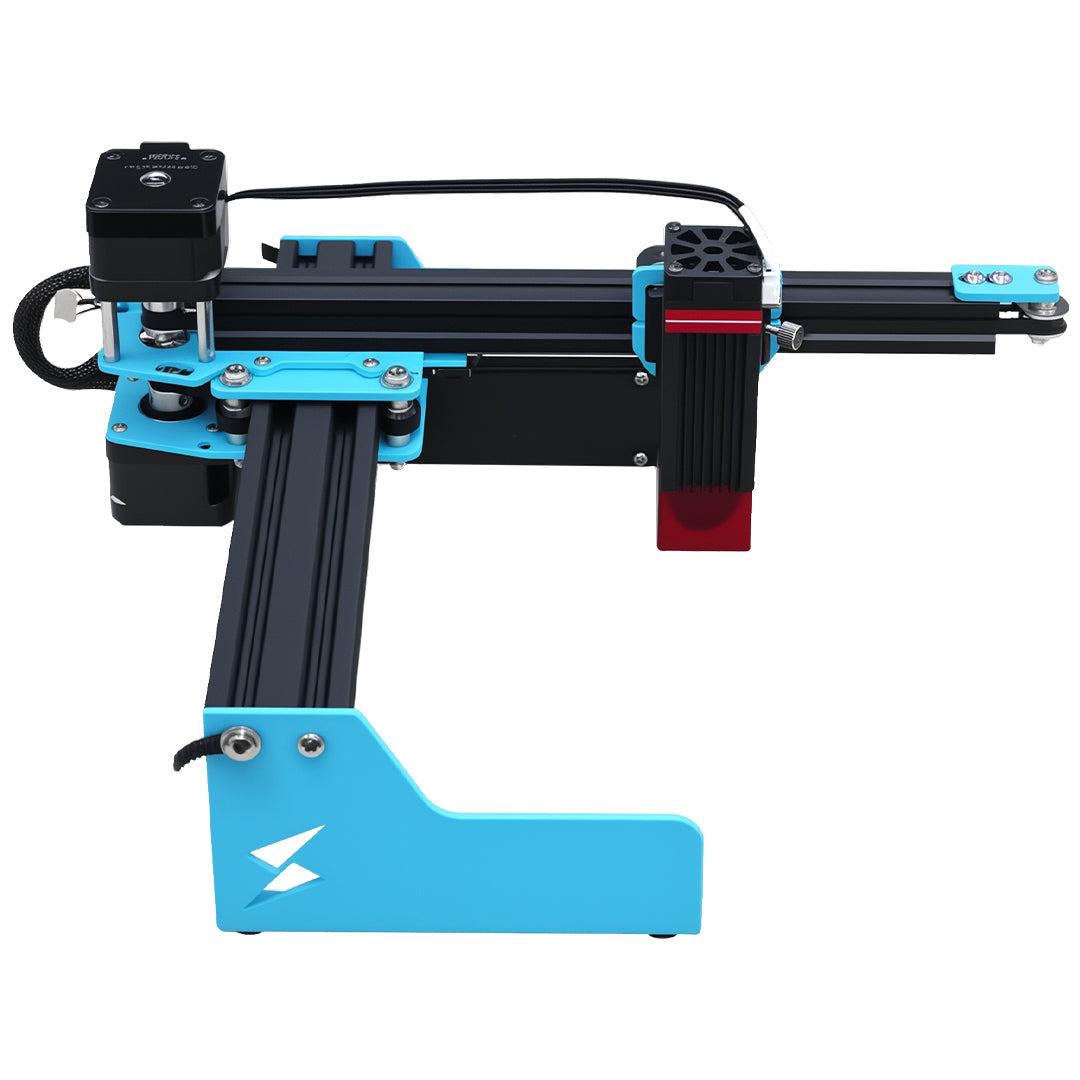
The TYVOK X1S Pro is listed for an 800 × 2000 mm large-format diode workflow. Confirm the actual usable stock area and configuration; the nominal machine area does not establish that a solver placed all requested parts or that its output fits your sheet.
A complete count still requires checking strip output against finite sheets. In the cutting software, remember that Cut Selected Graphics is not a crop at the bed boundary. Selecting objects does not repair an incomplete nest or safely truncate oversized geometry.
Buyer questions
Should I just increase the solver time until every part appears?
More time may help some searches, but first inspect quantities, import warnings and constraints. Missing input geometry or an impossible stock restriction will not necessarily be corrected by waiting.
Is the total piece count enough for approval?
No. Reconcile each part type and size, then check the total. Similar outlines can hide a shortage of one component behind an excess of another.