

5 Reasons Why Galvo Laser Engraving is Faster than Traditional Gantry Lasers
If you've been doing laser engraving for a while, you've probably heard about galvo lasers and how much faster they are than traditional gantry diode lasers. But why exactly are they so much faster? What's the difference in how they work that makes galvo lasers like the Tyvok P2 so much quicker for engraving?

In this article, we're going to break down the key reasons why galvo laser engraving is so much faster than traditional gantry systems, and when you should consider upgrading to a galvo like the Tyvok P2 for your own workshop.
What's the Difference Between Galvo and Gantry?
Before we get into the reasons why galvo is faster, let's quickly recap how each system works.
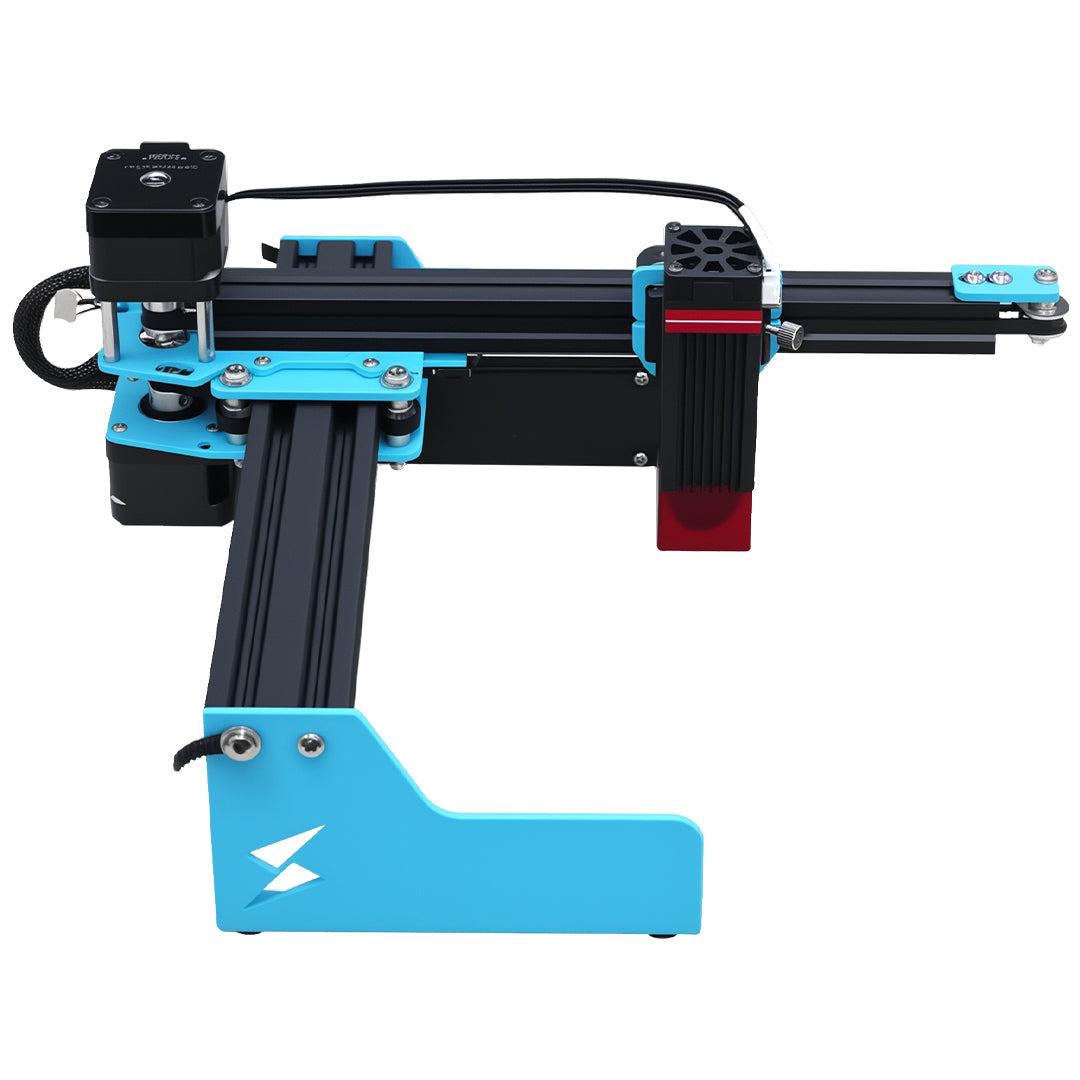
Traditional Gantry Laser: In a traditional gantry system like the Tyvok A1 Mini, the entire laser module moves along the X and Y axes on a mechanical gantry. To engrave a design, the gantry has to physically move the laser module across the entire surface of your material. Every point in the design requires moving the entire mass of the laser module and the gantry carriage.
Galvo Laser: In a galvo system like the Tyvok P2, the laser stays completely stationary. Instead of moving the entire laser module, the laser beam is bounced off two small mirrors mounted on galvanometer motors. These mirrors pivot very quickly to direct the laser beam across your material. No heavy mass has to move across the entire working area – just the tiny mirrors pivot in place.
That difference in how the laser gets moved across the material is what makes all the difference in speed. Now let's look at the specific reasons why galvo is so much faster.
1. Galvo Mirrors Have Much Less Mass to Move
This is the biggest reason why galvo lasers are so much faster. Think about it: in a gantry system, you have to move the entire laser module, the carriage that holds it, and sometimes the entire gantry frame. That's a lot of mass.
A typical 10W diode laser module weighs several hundred grams, plus the carriage it's mounted on adds more weight. When you add it all up, you're moving hundreds of grams of mass across the working area for every engraving.
Accelerating and decelerating all that mass takes time. You can only go so fast before you start getting overshoot, where the inertia of the moving mass causes the laser to go past where it's supposed to stop. This ruins the accuracy of your engraving. So you have to keep the speed down to maintain accuracy.
In a galvo system, all you're moving are two tiny mirrors. Each mirror weighs just a few grams. That's it. There's almost no mass to accelerate and decelerate. The mirrors can pivot back and forth extremely quickly without any overshoot or loss of accuracy.
Because there's so little mass, the galvo mirrors can change direction in milliseconds. You can't do that with a heavy gantry system. The difference in mass is the fundamental reason why galvo systems can achieve engraving speeds that are 20-30 times faster than gantry systems.
2. No Inertia-Related Accuracy Limits
When you're moving a lot of mass, inertia becomes a problem. Every time you change direction, the momentum of the moving mass wants to keep going in the original direction. To compensate for this, you either have to slow down, or you lose accuracy.
With a gantry system, if you try to go too fast, you get several problems:
- Overshoot: When the gantry is moving quickly and needs to stop, it doesn't stop exactly where it's supposed to – it goes a little past because of inertia. This makes your engravings blurry and inaccurate.
- Ringing: When you have sharp corners in your design, the inertia of the gantry causes it to "ring" or oscillate a little after changing direction. This creates visible artifacts in your engraving.
- Wear and Tear: Running a heavy gantry at high speeds all the time causes more wear on the belts, bearings, and motors, which can lead to more maintenance and shorter machine life.
Galvo systems don't have these problems because the mass is so low. The mirrors can change direction almost instantly with no overshoot and no ringing. You can run at full speed and still maintain the 0.01mm accuracy that the Tyvok P2 is capable of.
Because you don't have these inertia-related accuracy limits, you can run at much higher speeds while still maintaining the accuracy that's needed for detailed engravings.
3. The Laser is Always on the Move (No Dwell Time Needed for Steps)
In a gantry system, when you engrave a bitmap or a photo, the laser has to stop at every pixel to fire, then move to the next pixel, stop, fire again, and so on. This start-stop motion takes time. Every stop and start adds a little delay, and those delays add up over thousands or millions of pixels.
With a galvo system, the mirrors can move continuously across the surface while the laser is firing. You don't need to stop at every pixel. The beam is always moving, and the mirrors can adjust their position on the fly. This continuous motion is much faster than the stop-start motion of a gantry system.
Even when doing vector engraving, the galvo can move from one point to the next much faster because it doesn't have to accelerate and decelerate a lot of mass. The time saved on every move adds up to much faster overall job times.
Let's look at a real-world example: a detailed 50mm x 50mm photo engraving. On a 10W gantry diode laser like the Tyvok A1 Mini, this might take 5-8 minutes. On the Tyvok P2 10W galvo, the same engraving can be done in 30-45 seconds. That's a difference of 10x just from the faster movement and continuous motion.
4. Higher Maximum Speeds Mean Less Time Per Job
Because of the lower mass and lack of inertia issues, galvo lasers can have much higher maximum movement speeds. The Tyvok P2 can do up to 12000mm per second. Compare that to a typical gantry diode laser like the Tyvok A1 Mini, which has a maximum speed of around 500mm per second.
That means the maximum speed of the P2 is 24 times faster than the A1 Mini. In practice, you don't always run at maximum speed – you adjust your speed based on the power you need for the material you're engraving. But even when you're running slower than maximum speed, the galvo is still much faster than the gantry.
When you're doing a production run of dozens or hundreds of small items, this difference in speed is transformative. What would take you an entire day on a gantry can be done in an hour or less on a galvo. This means you can take on more orders and make more money in the same amount of time.
5. No Belt Stretch or Mechanical Slop to Limit Speed
In a gantry system, the movement is usually driven by belts. Belts are fine for lower speeds, but when you try to run at higher speeds, belt stretch becomes an issue. When the motor changes direction suddenly, the belt stretches a little bit before the carriage actually moves. This introduces a delay and a little bit of inaccuracy.
To avoid this inaccuracy, you have to run slower. If you run too fast, the belt stretch causes your engravings to be inaccurate and blurry, especially when changing direction.
Galvo systems don't use belts for moving the mirrors. The mirrors are directly mounted to the galvanometer rotors, so there's no belt stretch, no mechanical play, and no slop. The movement is direct from the motor to the mirror. This means you can run at very high speeds without any loss of accuracy from mechanical issues.
The lack of belts also means less maintenance. You don't have to retension belts periodically, and there's no belt wear over time. A good galvo system like the Tyvok P2 will maintain its accuracy for years with minimal maintenance.
When Does the Speed Advantage Really Matter?
The speed advantage of galvo lasers is always nice to have, but it really matters in certain situations:
1. Production Work and Bulk Orders
If you're running a business and you need to do a lot of engraved items – like wedding favors, corporate giveaways, or multiple customer orders – the speed of galvo is a game-changer. What used to take you all day now takes you an hour or two.
2. On-Demand Engraving at Events
Many people bring their galvo laser to craft fairs, markets, or events and do on-demand engraving for customers. With the speed of galvo, you can do an engraving in a minute or less while the customer waits. You can't do that with a gantry laser – the customer would get tired of waiting and leave.
3. Photo Engraving
Photo engraving requires a lot of detailed information, so it's inherently time-consuming on a gantry. With galvo, even a detailed photo can be done in under a minute. This makes photo engraving practical for production that you couldn't do on a gantry.
4. When Engraving is the Bottleneck in Your Workflow
Many small laser businesses have the A1 Mini for cutting and then add the P2 for engraving. The cutting doesn't take that much time, but the engraving is the bottleneck. Adding a P2 removes that bottleneck and lets you process many more orders per week without working longer hours.
Does Galvo Have Any Disadvantages Compared to Gantry?
Galvo is much faster for engraving, but it's not better at everything. Galvo systems like the Tyvok P2 typically have a smaller working area than most gantry systems – the P2 has 100mm x 100mm, which is perfect for small items, but not so great for large signs.
And as we mentioned earlier, gantry systems like the Tyvok A1 Mini are much better at cutting thicker materials because they can do multiple passes over a larger area. Galvo is great for engraving and cutting thin materials, but it's not practical for cutting thick materials.
That's why the most popular setup for small businesses is to have both: a Tyvok A1 Mini for cutting out your shapes, and a Tyvok P2 for fast engraving. This combination gives you the best of both worlds – you get the cutting capability of the gantry with the blazing speed of galvo for engraving.
How Much Faster is the Tyvok P2 Really?
Let's look at some real-world time comparisons to give you an idea:
| Job Type | Time on A1 Mini (10W Gantry) | Time on P2 (10W Galvo) |
|---|---|---|
| 30mm x 10mm text engraving | 1-2 minutes | 5-10 seconds |
| 50mm x 50mm logo engraving | 3-5 minutes | 15-30 seconds |
| 75mm x 75mm photo engraving | 8-12 minutes | 45-60 seconds |
| 50 x 30mm keychain engravings (batch of 20) | 100-160 minutes | 8-15 minutes |
As you can see, the difference is dramatic. For a batch of 20 keychains, what takes almost 3 hours on the A1 Mini takes less than 15 minutes on the P2. That time saved is money in your pocket when you're running a business.
Should You Upgrade to a Galvo Like the Tyvok P2?
So when should you consider upgrading from a gantry to a galvo? Here are some questions to ask yourself:
-
Are you waiting for engraving jobs to finish before you can move on to the next order? If engraving is the bottleneck in your workflow, the P2 will immediately solve that problem.
-
Do you get bulk orders for multiple engraved items? If you're doing wedding favors, corporate events, or any kind of bulk order, the speed of the P2 will save you so much time.
-
Do you want to do on-site engraving at events or markets? If you want to do engraving while customers wait, you need the speed of galvo.
-
Are you happy with your current machine for cutting, but you just need faster engraving? This is the perfect scenario for adding a P2 to your workshop. Keep using your A1 Mini for cutting, use the P2 for engraving.
If none of these apply to you and you're just starting out, you're probably fine starting with a Tyvok A1 Mini – it's the perfect entry point, and you can always add a P2 later when you need more speed.
Getting the Best Results from Your Galvo
Whether you have a Tyvok P2 or another galvo laser, there are a few things you can do to get the best results:
-
Use a quality honeycomb platform – A Tyvok engraving platform in the correct size for your galvo improves ventilation and prevents back burning, just like it does for gantry machines.
-
Always check your focus – Galvo lasers use fixed focus, so it's critical that your material is exactly the right distance from the lens. Use the focus gauge every time you change material thickness.
-
Keep your lens clean – Just like with any laser, smoke residue builds up on the lens over time. Clean it regularly to maintain maximum power and consistent engraving quality.
-
Start with the recommended settings – Galvo lasers use different speed and power settings than gantry lasers because the speed is so much higher. Start with the recommended settings for your material and adjust from there.
Final Thoughts
The fundamental difference in how galvo and gantry lasers move the beam – moving tiny mirrors vs moving a heavy gantry – is why galvo is so much faster. The lower mass, lack of inertia, and direct drive of the galvo mirrors allow engraving speeds that are simply impossible with a traditional gantry system.
The Tyvok P2 brings this galvo speed to the small business and hobbyist market at an affordable price, something that just wasn't possible a few years ago. Before the P2, you had to spend thousands of dollars to get a galvo laser, putting it out of reach for most small businesses and hobbyists. Now you can get a quality 10W galvo for a fraction of that price.
Whether you're just getting started and you need an entry-level machine, or you've been in business for a while and you need to speed up your engraving, Tyvok has you covered with the A1 Mini for entry-level versatility and the P2 for blazing fast galvo engraving.
Ready to experience the speed of galvo for yourself? Learn more about the Tyvok P2 10W galvo laser and see how it compares to the Tyvok A1 Mini entry-level gantry laser. Don't forget to pair your new galvo with a perfectly sized Tyvok engraving platform for the best results.