

Check whether the pencil can remain on one eligible face in a manufacturer-approved support arrangement before preparing a name. A round barrel can roll, and a hexagonal barrel can tip onto an adjacent face. Neither condition is solved by aligning the artwork more carefully on screen.

A personalized school-pencil discussion includes questions about keeping spacing and replacement positioning consistent. Its competitor fixture is project evidence, not an accessory compatibility promise for the A1 Mini. The useful question is how the actual blank will stay in the same physical orientation.
Classify the barrel with the machine idle
Inspect an unprocessed pencil. Is the intended surface flat, rounded or interrupted by a logo or coating change? Measure the face that would carry the text, not the pencil's maximum diameter. Note the ferrule and eraser as separate components to keep clear of the process.
Verify the barrel material and finish before considering laser use. An ordinary school pencil may have an unknown coating; a decorative appearance is not evidence of approval. If the supplier cannot identify the construction or the required support is not allowed, choose another method or a separate approved flat name item.
Decide whether stable support is actually available
| Pencil characteristic | Physical check | A1 Mini decision |
|---|---|---|
| Round barrel | Does it roll in the proposed approved arrangement? | Do not proceed with an unstable curved surface |
| Hexagonal barrel | Does one face remain level without tipping? | Evaluate that face and its usable width |
| Long overall body | Is it fully supported with required clearance? | Do not infer support from artwork size alone |
| Fixture contact | Is restraint outside the marking and movement paths? | Confirm the arrangement in machine guidance |
| Different replacement pencil | Are face dimensions and finish unchanged? | Recheck before treating it as the same blank |
Perform the support assessment without powered operation. Do not improvise a rotary connection or place unapproved fixture materials in the path. A successful stationary check is a prerequisite, not permission to bypass the machine's normal framing, protective and operating procedures.
Record a face, not just a coordinate
For an approved sample, record which face carries the name and which physical feature establishes the orientation. Photograph the setup for comparison. The focus-card photo record can help document the sample, but a photograph cannot prove that a different pencil will sit at the same height.
After support and material eligibility are established, use the sharpening-zone placement check to decide where the name belongs along the pencil. Keeping these decisions separate avoids a neatly positioned name on a blank that moves.
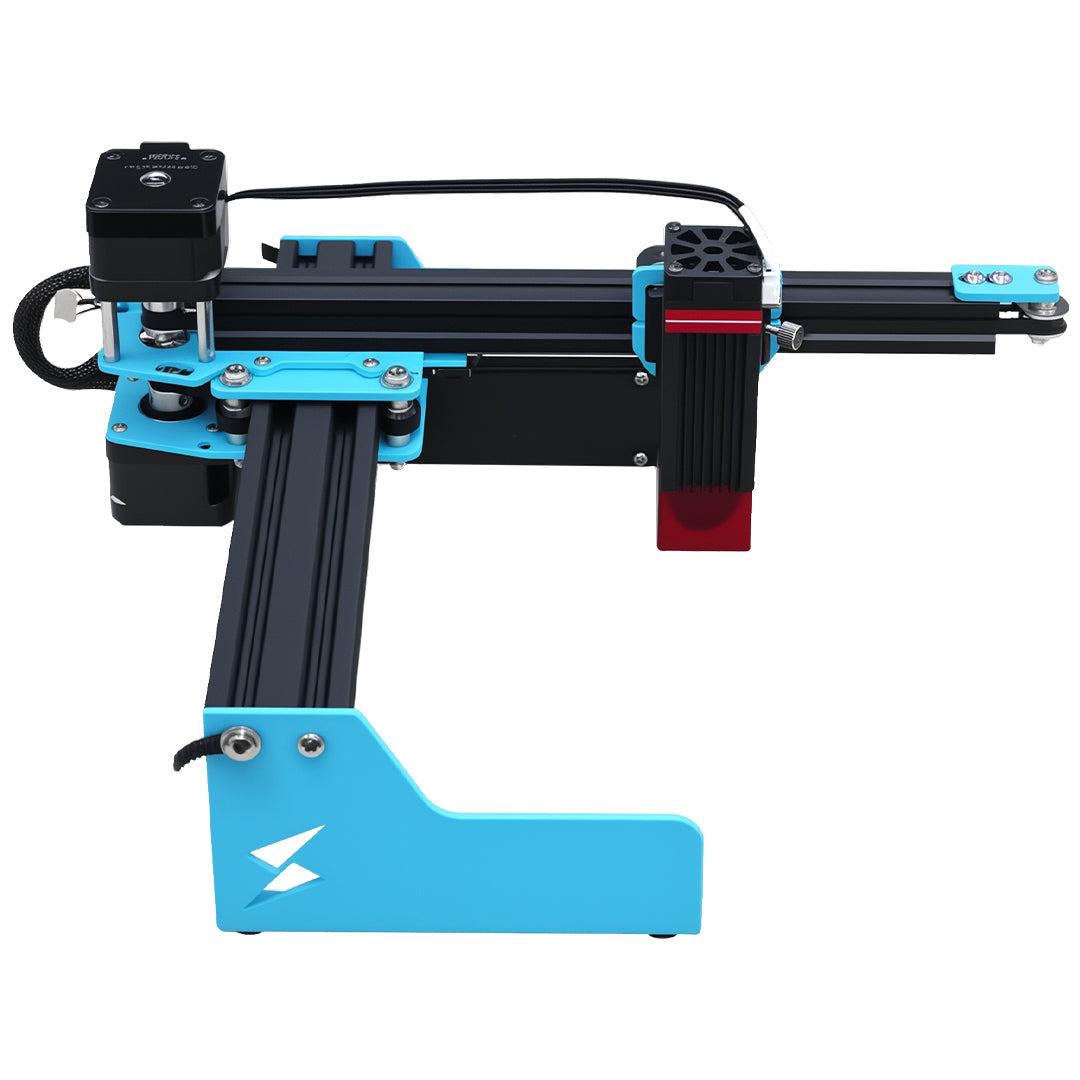
The A1 Mini product page lists a 120 × 130 mm work area. That number describes the working region; it does not establish that every longer object can safely overhang it or that a pencil jig is included. Confirm the complete physical arrangement before any sample run.
Can I hold the pencil still with my hand?
No. Use only the approved support and restraint arrangement with hands clear during operation. If a stable arrangement is unavailable, stop and choose a different blank or process.
Is a hexagonal pencil automatically suitable?
No. The face may be too narrow, the finish unknown or the overall pencil unsupported. Its shape is one input to the decision, not a substitute for material and setup approval.