

For a working clock, place hour marks along twelve directions separated by 30 degrees from the movement center. If those rays meet a square boundary, the distances between marks along each edge will not be equal. Equal edge spacing is a different decorative choice and can make the hands point between the expected numbers.

An April 2026 square-clock layout question asks how to distribute the numbers evenly. The key is deciding what evenly means before copying a circular array or dividing the perimeter into twelve equal pieces.
Work through a 300 mm square
Use a square positioning boundary centered at the movement shaft, with half-width a = 150 mm. Treat these coordinates as number-center guides; leave a separate outer margin for the glyphs and the physical panel edge. Measure angle theta clockwise from twelve o'clock.
For each hour direction, calculate t = a / max(abs(sin theta), abs(cos theta)). The point on the square is x = t × sin theta and y = t × cos theta, with positive y pointing upward in this example. Adapt the signs to the coordinate convention of the drawing application.
| Hour | Angle from twelve | x, mm | y, mm |
|---|---|---|---|
| 12 | 0° | 0 | 150 |
| 1 | 30° | 86.6 | 150 |
| 2 | 60° | 150 | 86.6 |
| 3 | 90° | 150 | 0 |
Reflect this pattern into the remaining quadrants. From twelve to one, the distance along the top edge is about 86.6 mm. From one to two, traveling through the corner covers about 126.8 mm. Those unequal perimeter distances are consistent with equal 30-degree directions from the center.
By contrast, dividing the 1,200 mm perimeter into twelve equal intervals gives 100 mm per interval. Starting at the top midpoint, the next point is x = 100, y = 150. Its direction is about 33.7 degrees from vertical, rather than 30 degrees. That mismatch is visible when a clock hand points toward the one-hour position.
Separate numeral placement from numeral rotation
The hour locations and the orientation of the printed numbers are separate choices. Upright numerals can share radial positions without rotating each numeral to face the center. Also inspect broad characters such as 12 and 10: centering their bounding boxes is only a starting point for visual balance.
The same distinction between spacing measurements appears in center-pitch versus edge-gap calculations. Before ordering a panel, make a full-size paper proof, mark the movement center and use a straightedge along each hour direction to check alignment without powering the laser.
Apply the layout to an X1S 2026 project
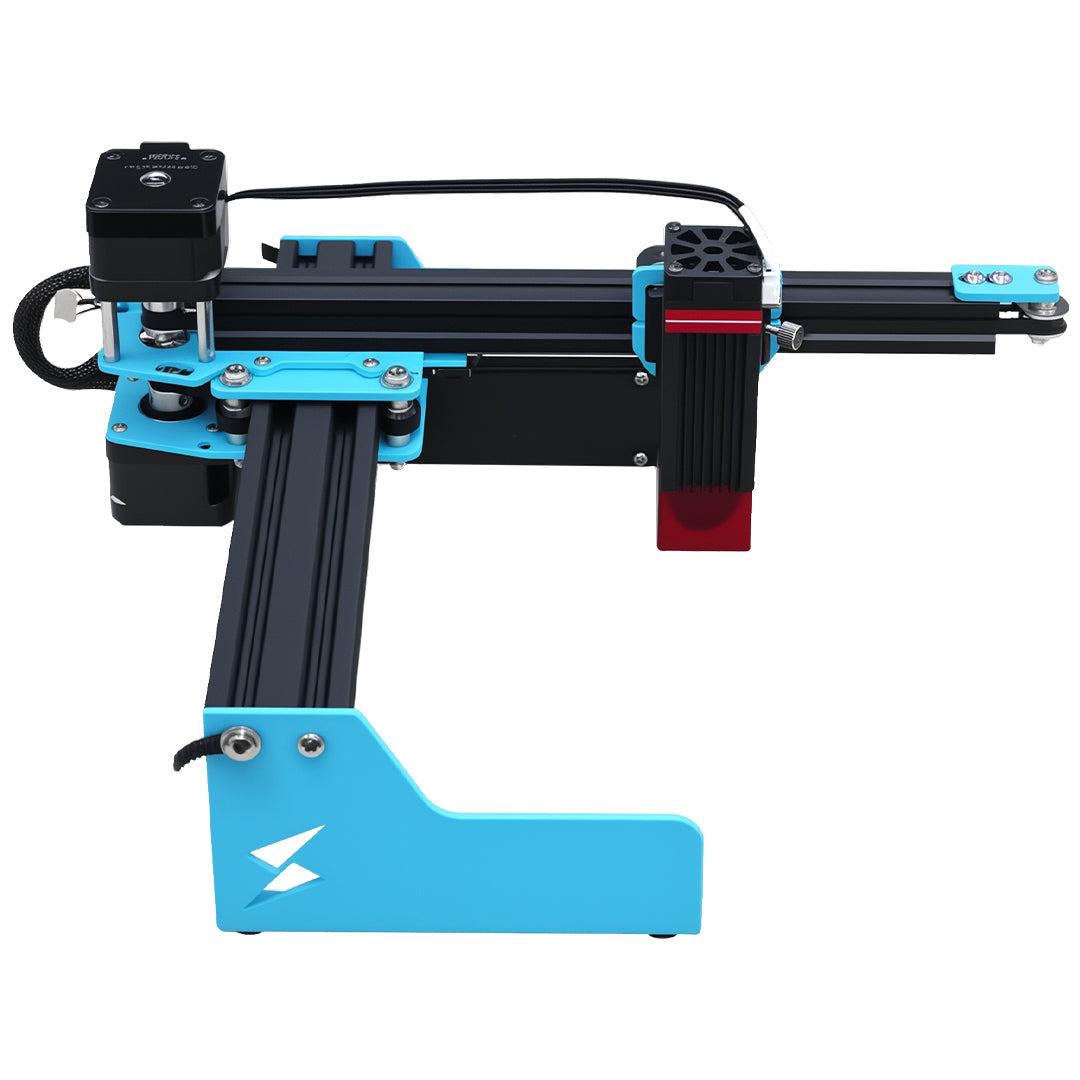
The X1S 2026 page describes an 800 × 800 mm starting work area and an expansion path. Verify the actual setup and suitable material before manufacture. The coordinate example fits a drawing exercise; it does not specify movement-hole diameter, shaft length, mounting method or safe finished-clock construction. Obtain those requirements from the chosen movement and panel design.
Can I simply put a circular number layout inside a square panel?
Yes. A circular number arrangement retains regular hour angles and can sit inside a square outer shape. You only need the ray-to-square construction when the number positions themselves follow a square boundary.
Should the numbers sit exactly on the cut edge?
No. Use an inset positioning boundary with enough room for the full characters and physical design margin. Check the widest numeral and the movement center on the paper proof.
Check the machine before buying
For the material and workflow discussed above, review TYVOK X1S 2026 configurations and purchase options after testing the exact project materials and setup.