

Test a wooden bobbin's notch with the actual thread before engraving its label. The tail should stay tucked during ordinary handling and release without being pulled hard across a sharp edge. A neat-looking notch is not proof that it works equally well with thin embroidery floss and thicker yarn.

This wooden floss-bobbin collection shows several spool-card shapes for organizing thread. A tail-retention check is a practical way to select a suitable precut blank from that kind of design, before spending time on personalized labels.
Test a short length before winding a whole skein
Start with a spare blank whose wood and finish are known. With no laser involved, wrap a small amount of the intended thread around it and place the end in the notch. Turn the bobbin over, set it down and pick it up again. Observe whether the tail escapes or requires force to release.
Look closely at the contact point. A notch that pinches sharply may damage the fibers even when it holds well. A wide rounded opening may release too easily. Do not treat a forceful tug as a successful retention test; inspect the removed thread for fuzzing and compare it with an untouched length.
| A1 bobbin preparation | Acceptable observation | Reason to stop |
|---|---|---|
| Gentle tuck and removal | Tail seats and releases smoothly | Snagging or visible fibers left behind |
| Normal handling | Tail remains in place | Thread unwinds from the card |
| Edge inspection | Clean, smooth contact surface | Splinter or sharp charred edge |
| Label location | Code remains visible when wound | Thread hides the identification |
Add the label after the functional check
Remove every strand before engraving. Use the bobbin label-readability proof to position the thread code outside the wound area. If the bobbin will hold yarn for a frame loom, record a useful identifier that matches your warp-spacing sample, rather than only an arbitrary number.
A visible pattern key on a weaving comb serves a different purpose from a storage label. Keep detailed pattern instructions on the working tool or project notes, while the bobbin carries the information needed to identify its contents quickly.
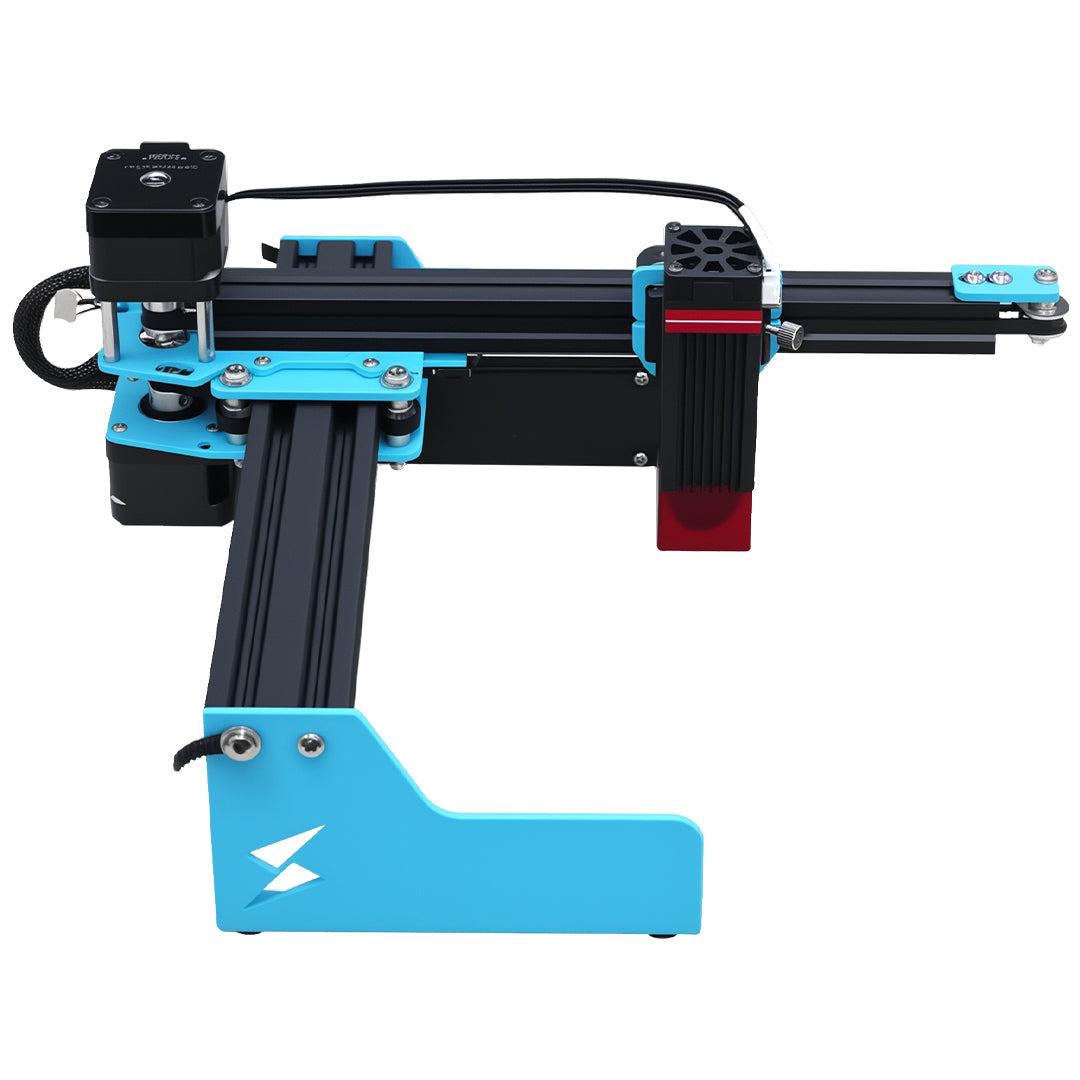
The A1 Mini is a compact engraver with a 120 × 130 mm work area. A compatible precut wooden bobbin avoids assuming the machine can cut any downloaded design or thickness. Support it securely and follow the machine's focus, ventilation, protection and supervision instructions. Unknown plastics, PVC, vinyl and unidentified coatings are unsuitable substitutes for a verified blank.
Can I widen the notch with another laser pass?
Do not guess at a corrective pass on a finished piece. Select or prepare a suitable replacement blank through a verified method, then repeat the mechanical thread test before marking its label.
Should one notch work for every thread in my kit?
Not necessarily. Test the thinnest and thickest thread you intend to store. Separate blank styles may be more practical than forcing a single notch to grip very different fibers.