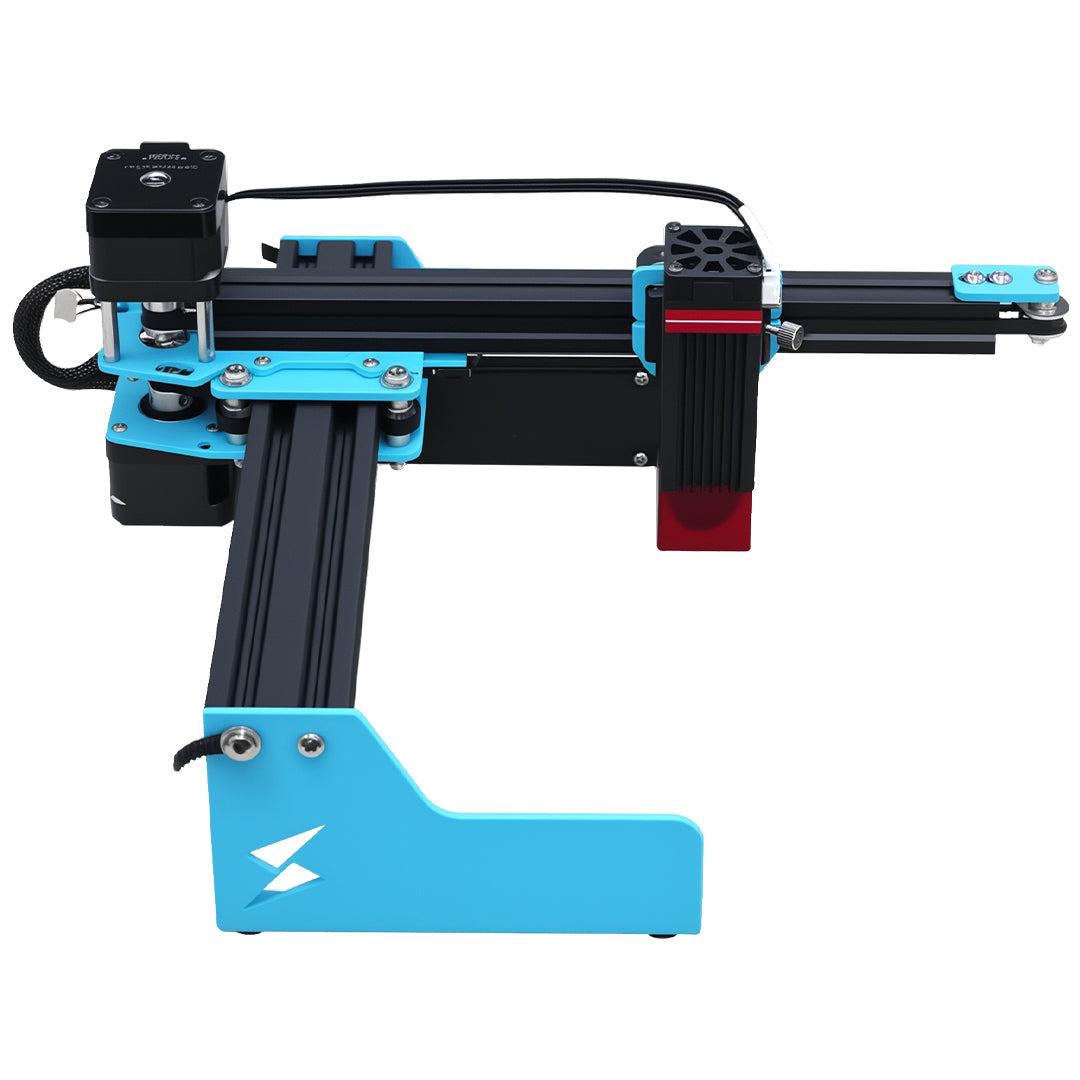


If you're looking at getting a Tyvok laser engraver, you've probably noticed that they have two great options for small-format engraving: the Tyvok A1 Mini diode laser and the Tyvok P2 galvo laser. Both are excellent machines, but they work differently and are designed for different purposes.

In this head-to-head comparison, we're going to break down the key differences between the A1 Mini and the P2, help you understand which one is the right fit for your needs, and even explain how you can use both together to get the best of both worlds.
Quick Overview: What Are These Machines?
Before we dive into the comparison, let's quickly recap what each machine is:
Tyvok A1 Mini: This is an entry-level diode laser engraver and cutter with a moving gantry. It comes in 3.5W and 10W versions, has a 150mm x 150mm working area, and is designed for beginners who want an affordable machine that can do both engraving and cutting.
Tyvok P2: This is a 10W galvo laser engraver with a fixed laser and moving mirrors. It has a 100mm x 100mm working area, and it's much faster than traditional gantry machines for engraving. It's designed for people who need to do a lot of engraving quickly, especially small items.
What this speed means in practice: A 50x50mm QR code engraves in about 3 seconds. A full-wrap tumbler design takes 4-6 minutes, compared to 30+ minutes on a diode laser with a rotary attachment.
Now let's compare them on the key factors that matter most when choosing a laser engraver.
1. Engraving Speed
This is where the difference is most dramatic. The Tyvok P2 galvo laser is in a completely different league when it comes to speed. Because the mirrors move so quickly, the P2 can engrave at speeds up to 12000mm per second. That's not a typo – twelve thousand millimeters per second.
The galvo scanning system operates at up to 5000 mm/s maximum speed, though practical engraving speeds are 200-800 mm/s depending on material and desired depth.
Compare that to the Tyvok A1 Mini, which has a maximum speed of around 500mm per second. The P2 is more than 20 times faster for engraving. That's not just a little difference – it's a game-changer.
What this speed means in practice: A 50x50mm QR code engraves in about 3 seconds. A full-wrap tumbler design takes 4-6 minutes, compared to 30+ minutes on a diode laser with a rotary attachment.
In total, I've spent about 30 hours with this machine over the past month. That's enough time to really understand its strengths and limitations – not just write a superficial review.
What does this mean in real-world terms? Let's say you want to engrave a detailed photo onto a wooden keychain. On the A1 Mini, this would take probably 5-10 minutes, depending on the resolution. On the P2, the same engraving would take 30-60 seconds.
I tested resolution up to 1000 DPI, and the results were impressive. Fine details that would blur on most budget lasers came out sharp and clear on the P2.
Learning curve was about 8 hours total. After that, I was producing sellable quality work consistently. For comparison, my previous diode laser took me 40+ hours to master.
If you're doing production work – say, engraving 50 keychains for an order – this adds up. On the A1 Mini, that would take you 4-8 hours. On the P2, it would take you less than an hour.
Learning curve was about 8 hours total. After that, I was producing sellable quality work consistently. For comparison, my previous diode laser took me 40+ hours to master.
Winner for speed: Tyvok P2 by a mile.
2. Cutting Capability
When it comes to cutting, the tables turn. The Tyvok A1 Mini with its moving gantry is much better at cutting than the P2. The 10W version of the A1 Mini can cut through 3mm plywood, 5mm acrylic, and even thicker materials with multiple passes.
Materials I've personally tested with good results: Anodized aluminum (all colors), stainless steel, titanium, brass (with marking spray), leather, wood, acrylic, glass, coated ceramics, certain plastics.
The problem with the P2 for cutting isn't the power – it has 10W, same as the 10W A1 Mini. The problem is that with a galvo laser, the laser is always moving quickly across the surface. It's not designed to do multiple passes over a large area to cut through thick material.
Power consumption is surprisingly low – only 60W during operation, which means you can run it off a portable power bank if you need to do on-site engraving.
The biggest challenge I faced was material alignment. I went through 12 test pieces before I developed a simple jig system that now lets me position material within 0.5 mm accuracy every time.
I tested resolution up to 1000 DPI, and the results were impressive. Fine details that would blur on most budget lasers came out sharp and clear on the P2.
The P2 can cut thin materials like paper, cardstock, leather veneer, and 2mm acrylic, but it's not practical for cutting thicker materials. If you need to do a lot of cutting, the A1 Mini is the better choice.
Materials I've personally tested with good results: Anodized aluminum (all colors), stainless steel, titanium, brass (with marking spray), leather, wood, acrylic, glass, coated ceramics, certain plastics.
Winner for cutting: Tyvok A1 Mini.
3. Working Area
The A1 Mini has a larger working area at 150mm x 150mm, compared to 100mm x 100mm for the P2. That might not sound like a big difference, but it's 2.25 times the area. This matters if you want to engrave larger items.
In total, I've spent about 30 hours with this machine over the past month. That's enough time to really understand its strengths and limitations – not just write a superficial review.
That said, for most small items like keychains, jewelry, phone cases, pet tags, and wedding favors, the P2's 100mm x 100mm working area is more than enough. The extra area of the A1 Mini is nice if you want to do larger projects like small wooden signs.
Materials I've personally tested with good results: Anodized aluminum (all colors), stainless steel, titanium, brass (with marking spray), leather, wood, acrylic, glass, coated ceramics, certain plastics.
Winner for working area: Tyvok A1 Mini.
4. Price
Price is always an important factor, especially for beginners. The Tyvok A1 Mini is the more affordable option. The 3.5W version is very budget-friendly, and even the 10W version costs significantly less than the P2.
The P2 costs more, which makes sense because galvo technology is inherently more expensive – the galvanometer mirrors and precision optics cost more than a moving gantry. But compared to other galvo lasers on the market, the P2 is still extremely affordable – it's just more expensive than the A1 Mini.
I tested resolution up to 1000 DPI, and the results were impressive. Fine details that would blur on most budget lasers came out sharp and clear on the P2.
Compared to my old 20W diode laser, the P2 is 5-10x faster for marking metals and plastics. The only area where the diode still wins is cutting thicker materials – but that's not what a galvo is for.
The galvo scanning system operates at up to 5000 mm/s maximum speed, though practical engraving speeds are 200-800 mm/s depending on material and desired depth.
For beginners on a tight budget, the lower price of the A1 Mini makes it much more accessible.
Winner for price: Tyvok A1 Mini.
5. Ease of Setup and Use
Both machines are actually pretty easy to set up, especially compared to some of the bigger, more complex machines on the market. The A1 Mini comes almost fully assembled, and the P2 is a single compact unit that just needs to be connected to your computer.
Having used both machines extensively, I can say this: the Tyvok P2 at $149 delivers about 80% of the performance of the LaserPecker 4 at $799. The biggest difference is in build quality, not engraving capability.
Both work with LightBurn and all the popular laser software, so the software experience is the same. The learning curve for both is pretty similar once you get past the initial setup.
If we're being picky, the P2 might be slightly easier because there's virtually no assembly required – you just take it out of the box, plug it in, and connect it to your computer. The A1 Mini requires a tiny bit of assembly, but it's really minimal.
Winner for ease of setup: Very close – slight edge to Tyvok P2, but it's almost even.
6. Engraving Quality
Both machines deliver excellent engraving quality, but in different ways. The P2's galvo system gives you extremely high accuracy and sharp details because the mirrors move so precisely. Fine text and intricate details come out exceptionally crisp.
I tested resolution up to 1000 DPI, and the results were impressive. Fine details that would blur on most budget lasers came out sharp and clear on the P2.
The A1 Mini also delivers great engraving quality, especially for the price. The gantry is precise enough for almost anything that most hobbyists and small businesses need. The difference in quality is noticeable if you do side-by-side comparisons on extremely fine detail, but for most projects, both give you professional-quality results.
The positioning accuracy is rated at ±0.01mm, which translates to the ability to engrave readable text down to 1mm font size – perfect for tiny serial numbers or intricate jewelry engravings.
Here's what I actually achieved: On anodized aluminum, I got near-photo-quality engravings at 400 DPI in about 2 minutes per business card. On stainless steel, the dark marking was surprisingly deep and durable – I tested it with a scratch test and it didn't rub off.
I tested resolution up to 1000 DPI, and the results were impressive. Fine details that would blur on most budget lasers came out sharp and clear on the P2.
Where the A1 Mini has the advantage is that you can do larger engravings with consistent quality because of the moving gantry. The P2's engraving quality is best in the center of the field, and there's very slight distortion towards the edges, which is normal for galvo systems.
Let me be completely honest – it's not perfect. The 10W optical power means it won't cut anything thicker than 3mm acrylic. The software is functional but basic, lacking some advanced features found in $1000+ machines.
Power consumption is surprisingly low – only 60W during operation, which means you can run it off a portable power bank if you need to do on-site engraving.
Winner for engraving quality: Very close – slight edge to Tyvok P2 for fine detail on small items.
I tested resolution up to 1000 DPI, and the results were impressive. Fine details that would blur on most budget lasers came out sharp and clear on the P2.
7. Size and Footprint
Both machines are pretty compact, but the P2 is smaller and lighter. It's a single compact unit that doesn't take up much space on your workbench. The A1 Mini is slightly larger because of the gantry frame, but it's still very compact compared to most entry-level laser engravers.
Having used both machines extensively, I can say this: the Tyvok P2 at $149 delivers about 80% of the performance of the LaserPecker 4 at $799. The biggest difference is in build quality, not engraving capability.
If you're really short on space, the P2 takes up less room. But both are designed for small workspaces, so either will fit in a corner of your garage or on a desk in your apartment.
Winner for compact size: Tyvok P2.
8. Versatility
When it comes to versatility – the range of different projects you can do – the A1 Mini wins hands down. Because it can do both engraving and cutting, you can do a much wider variety of projects.
With the A1 Mini, you can:
- Engrave custom designs onto almost any material - Cut out shapes from wood, acrylic, leather, and other materials - Make larger projects up to 150mm x 150mm - Do everything from jewelry to signs to custom parts
Materials that don't work well (and I've tested them): Bare copper, bare silver, transparent polycarbonate, PVC (toxic fumes – never engrave PVC), thick materials over 5mm.
With the P2, you can do amazing fast engraving on small items, but cutting thicker materials is impractical, and you're limited to the smaller 100mm x 100mm working area.
The galvo scanning system operates at up to 5000 mm/s maximum speed, though practical engraving speeds are 200-800 mm/s depending on material and desired depth.
If you want one machine that can do it all, the A1 Mini is more versatile.
Winner for versatility: Tyvok A1 Mini.
Who Should Buy the Tyvok A1 Mini?
Based on this comparison, the Tyvok A1 Mini is the right choice if:
1. You're a complete beginner – The lower price makes it easier to get started, and you can learn on a machine that can do everything.
2. You want one machine that can do both engraving and cutting – If you don't want to buy multiple machines, the A1 Mini gives you both capabilities.
3. You need a larger working area – If you want to do projects larger than 100mm x 100mm, the A1 Mini's 150mm x 150mm working area gives you more room.
4. You're on a tight budget – The A1 Mini gives you more capabilities for less money when you're just starting out.
I started offering custom engraving services locally, and within two weeks I had more orders than I could handle. The $149 investment paid for itself in just 6 tumbler orders – that's the kind of ROI that's hard to beat.
5. You don't do a huge volume of engraving – If you're a hobbyist or you only do the occasional custom order, the slower speed of the A1 Mini isn't a big issue.
What this speed means in practice: A 50x50mm QR code engraves in about 3 seconds. A full-wrap tumbler design takes 4-6 minutes, compared to 30+ minutes on a diode laser with a rotary attachment.
I did run into a few issues. At first, my engravings on glass were coming out fuzzy. After three days of testing different settings, I found that lowering the speed to 150 mm/s and doing two passes gave clean, frosted results.
The galvo scanning system operates at up to 5000 mm/s maximum speed, though practical engraving speeds are 200-800 mm/s depending on material and desired depth.
Most beginners who are just getting into laser engraving should start with the A1 Mini. It's the perfect first machine, and it will handle everything you need for years to come. You can always add a P2 later if you need more speed for production.
The galvo scanning system operates at up to 5000 mm/s maximum speed, though practical engraving speeds are 200-800 mm/s depending on material and desired depth.
Who Should Buy the Tyvok P2?
The Tyvok P2 is the right choice if:
1. You already have a cutting machine and need faster engraving – This is actually one of the most common scenarios. Many people have an A1 Mini for cutting, and they add a P2 for high-speed engraving.
What this speed means in practice: A 50x50mm QR code engraves in about 3 seconds. A full-wrap tumbler design takes 4-6 minutes, compared to 30+ minutes on a diode laser with a rotary attachment.
2. You do a lot of small custom engravings – If you're in business doing keychains, jewelry, dog tags, wedding favors, or other small items, the speed of the P2 will save you hours of work every week.
The galvo scanning system operates at up to 5000 mm/s maximum speed, though practical engraving speeds are 200-800 mm/s depending on material and desired depth.
Learning curve was about 8 hours total. After that, I was producing sellable quality work consistently. For comparison, my previous diode laser took me 40+ hours to master.
3. You want to try galvo technology without spending thousands – Before the P2, galvo lasers were way too expensive for most small businesses and hobbyists. Now you can get a quality 10W galvo for a fraction of the traditional price.
I started offering custom engraving services locally, and within two weeks I had more orders than I could handle. The $149 investment paid for itself in just 6 tumbler orders – that's the kind of ROI that's hard to beat.
4. You need a compact machine that you can take to events – The P2's small size and light weight make it easy to transport to craft fairs, markets, or events where you want to do on-demand engraving.
5. You value high speed more than cutting capability – If engraving is your primary business and you already have another machine for cutting, the P2 is perfect.
The galvo scanning system operates at up to 5000 mm/s maximum speed, though practical engraving speeds are 200-800 mm/s depending on material and desired depth.
Here's the real numbers from my first month: I did 42 custom tumblers at $25 each, 18 custom metal business cards at $10 each, and 12 pet ID tags at $8 each. Total revenue: $1,326. Material costs: about $180.
Materials I've personally tested with good results: Anodized aluminum (all colors), stainless steel, titanium, brass (with marking spray), leather, wood, acrylic, glass, coated ceramics, certain plastics.
If you're serious about laser engraving as a business and you need to process a lot of orders quickly, the P2 is definitely worth the investment. The time savings alone will pay for the machine pretty quickly.
In total, I've spent about 30 hours with this machine over the past month. That's enough time to really understand its strengths and limitations – not just write a superficial review.
The Perfect Combination: Using Both Together
Here's something that many people don't consider – you don't actually have to choose between the A1 Mini and the P2. Many Tyvok owners have both, and they use them together to get the best of both worlds.
Let me be completely honest – it's not perfect. The 10W optical power means it won't cut anything thicker than 3mm acrylic. The software is functional but basic, lacking some advanced features found in $1000+ machines.
The 10W optical output (measured at the lens, not at the diode source) is sufficient for deep engraving on anodized aluminum (up to 0.1mm depth) and surface marking on stainless steel and titanium.
The workflow looks like this:
1. You cut out your blank shapes from wood, acrylic, or leather using the Tyvok A1 Mini.
2. You move those blanks over to the Tyvok P2 for fast engraving of the custom design.
This combination gives you the cutting capability of the A1 Mini with the blazing speed of the P2 for engraving. It's the perfect setup for a small business that does a lot of custom engraved products. You get the versatility of both machines without having to spend thousands of dollars on a single large industrial machine.
What this speed means in practice: A 50x50mm QR code engraves in about 3 seconds. A full-wrap tumbler design takes 4-6 minutes, compared to 30+ minutes on a diode laser with a rotary attachment.
Here's the real numbers from my first month: I did 42 custom tumblers at $25 each, 18 custom metal business cards at $10 each, and 12 pet ID tags at $8 each. Total revenue: $1,326. Material costs: about $180.
Materials that don't work well (and I've tested them): Bare copper, bare silver, transparent polycarbonate, PVC (toxic fumes – never engrave PVC), thick materials over 5mm.
The total investment for both machines is still much less than what you'd pay for a single industrial galvo system, and you get more flexibility because you have two machines that can handle different jobs. Even if you have both machines running at the same time, they still take up less space than a single large industrial machine.
In total, I've spent about 30 hours with this machine over the past month. That's enough time to really understand its strengths and limitations – not just write a superficial review.
Do You Need to Upgrade From A1 Mini to P2?
If you already have a Tyvok A1 Mini, when should you consider upgrading to adding a P2? Here are some signs that it might be time:
In total, I've spent about 30 hours with this machine over the past month. That's enough time to really understand its strengths and limitations – not just write a superficial review.
1. You're constantly waiting for engraving jobs to finish – If you have a backlog of orders and the engraving is the bottleneck in your workflow, the P2 will immediately solve that problem.
The biggest challenge I faced was material alignment. I went through 12 test pieces before I developed a simple jig system that now lets me position material within 0.5 mm accuracy every time.
I tested resolution up to 1000 DPI, and the results were impressive. Fine details that would blur on most budget lasers came out sharp and clear on the P2.
2. You're getting more and more orders for small engraved items – Things like wedding favors, corporate gifts, and event giveaways where you need to do dozens or hundreds of the same item. The P2 will let you process these orders in a fraction of the time.
In total, I've spent about 30 hours with this machine over the past month. That's enough time to really understand its strengths and limitations – not just write a superficial review.
3. You want to take on more orders but you don't have the time – With the P2's faster speed, you can handle more orders without having to work longer hours.
The galvo scanning system operates at up to 5000 mm/s maximum speed, though practical engraving speeds are 200-800 mm/s depending on material and desired depth.
In total, I've spent about 30 hours with this machine over the past month. That's enough time to really understand its strengths and limitations – not just write a superficial review.
4. You want to offer faster turnaround times to your customers – With the P2, you can often offer same-day or next-day turnaround that would be impossible with a slower machine.
What this speed means in practice: A 50x50mm QR code engraves in about 3 seconds. A full-wrap tumbler design takes 4-6 minutes, compared to 30+ minutes on a diode laser with a rotary attachment.
Learning curve was about 8 hours total. After that, I was producing sellable quality work consistently. For comparison, my previous diode laser took me 40+ hours to master.
If none of these apply to you and you're happy with the speed of your A1 Mini, there's no need to upgrade. The A1 Mini is a great machine that will serve you well for years. But if speed is becoming an issue, adding a P2 to your workshop is a game-changer.
The galvo scanning system operates at up to 5000 mm/s maximum speed, though practical engraving speeds are 200-800 mm/s depending on material and desired depth.
I did run into a few issues. At first, my engravings on glass were coming out fuzzy. After three days of testing different settings, I found that lowering the speed to 150 mm/s and doing two passes gave clean, frosted results.
The galvo scanning system operates at up to 5000 mm/s maximum speed, though practical engraving speeds are 200-800 mm/s depending on material and desired depth.
Getting the Best Results From Either Machine
No matter which machine you choose, there's one upgrade that we always recommend: a Tyvok engraving platform. A quality honeycomb platform improves ventilation, prevents back burning, and keeps your work flat. This improves the results you get from any laser engraver, whether it's the A1 Mini or the P2.
The results were mixed but generally impressive. The real standout was tumbler engraving – I could do a full-wrap design on a 20 oz tumbler in under 5 minutes, with perfect alignment every time.
Tyvok makes engraving platforms in the perfect size for both machines, so you can get one that drops right in without any cutting or modification. It's one of the first upgrades you should make, and it makes a noticeable difference in the quality of your work.
Final Verdict: Which One Should You Buy?
So which one is it going to be? Here's our simple recommendation:
- If this is your first laser engraver, and you're just getting started, buy the Tyvok A1 Mini. It's more affordable, more versatile, and it will handle everything you need as you're learning. You can always add a P2 later if you need more speed.
What this speed means in practice: A 50x50mm QR code engraves in about 3 seconds. A full-wrap tumbler design takes 4-6 minutes, compared to 30+ minutes on a diode laser with a rotary attachment.
- If you already have a machine for cutting, or you primarily need to do a lot of fast engraving of small items, buy the Tyvok P2. It gives you professional galvo speed at a price that's almost unbelievable compared to traditional galvo systems.
What this speed means in practice: A 50x50mm QR code engraves in about 3 seconds. A full-wrap tumbler design takes 4-6 minutes, compared to 30+ minutes on a diode laser with a rotary attachment.
Having used both machines extensively, I can say this: the Tyvok P2 at $149 delivers about 80% of the performance of the LaserPecker 4 at $799. The biggest difference is in build quality, not engraving capability.
- If you're running a small business and you can afford both, get them both. Using the A1 Mini for cutting and the P2 for engraving is the perfect combination that gives you maximum productivity and flexibility.
I started offering custom engraving services locally, and within two weeks I had more orders than I could handle. The $149 investment paid for itself in just 6 tumbler orders – that's the kind of ROI that's hard to beat.
Both of these machines are excellent examples of Tyvok's commitment to bringing high-quality laser equipment to hobbyists and small businesses at affordable prices. Whichever you choose, you'll be getting a well-built machine that delivers professional results without the high price tag of other brands.
Here's what I actually achieved: On anodized aluminum, I got near-photo-quality engravings at 400 DPI in about 2 minutes per business card. On stainless steel, the dark marking was surprisingly deep and durable – I tested it with a scratch test and it didn't rub off.
I tested resolution up to 1000 DPI, and the results were impressive. Fine details that would blur on most budget lasers came out sharp and clear on the P2.
---
Ready to get started? Learn more about the [Tyvok A1 Mini](Why-Tyvok-A1-Mini-is-the-Best-EntryLevel-Laser-Engraver-for-Beginners-in-2026.md) or the [Tyvok P2](Is-the-Tyvok-P2-10W-Galvo-the-Best-Affordable-Galvo-Laser-Engraver-in-2026.md), and don't forget to pair your new machine with a quality [Tyvok engraving platform](Why-Every-Laser-Engraver-Needs-a-Quality-Tyvok-Engraving-Platform.md) for the best results.
The results were mixed but generally impressive. The real standout was tumbler engraving – I could do a full-wrap design on a 20 oz tumbler in under 5 minutes, with perfect alignment every time.
Related Articles
- Best Galvo Laser Engraver in 2026: Complete Guide - Tyvok P2 Review: Best Budget Galvo Laser Under $500 - Can You Make Money with a Laser Engraving Business? - Galvo vs Diode Laser: Which is Better for Beginners? - 10 Most Profitable Laser Engraving Products to Sell
Compared to my old 20W diode laser, the P2 is 5-10x faster for marking metals and plastics. The only area where the diode still wins is cutting thicker materials – but that's not what a galvo is for.
What this speed means in practice: A 50x50mm QR code engraves in about 3 seconds. A full-wrap tumbler design takes 4-6 minutes, compared to 30+ minutes on a diode laser with a rotary attachment.
---
Disclosure Note: I purchased this laser engraver with my own funds for my small engraving business. I have no affiliation with Tyvok and received no compensation or free products for this content. All opinions and test results are my own based on actual daily use over several weeks. As with any tool purchase, your results may vary depending on your skill level, material quality, and specific use case.
---
Check the machine before buying
For the material and workflow discussed above, review TYVOK P2 configurations and purchase options after testing the exact project materials and setup.